Building a digital coach, and changing the version that could not scale
OptimaLifts started as wearable sensors, reached a national startup final, went through a year-long
incubator track, and came out the other side as a software product. This case study covers the
decision to change direction.
Problem
People who lift weights get their execution and their intensity estimate wrong, and both are invisible to them.
My role
Co-founder & Product Designer, owning the vision, the roadmap, the user stories and the business model.
Team
4 co-founders, a hired computer vision engineer and 3 mentors
Timeline
Sep 2023 – Jul 2024
Outcome
JA Greece startup finalist and graduate of the year-long ACEin Compass Cycle incubator.
The problem
People who lift weights consistently get two things wrong. They get the execution
wrong, meaning technique, posture and tempo, and they get the intensity estimate
wrong, training either too far from failure to grow or too close to it to recover. Both are
invisible to the person doing them, which is why a coach is valuable.
The evidence behind the pitch, sourced rather than asserted:
53% have been injured at least once through incorrect execution of an exercise.
32% of those injuries left permanent pain.
47% misjudge the intensity they are actually placing on the muscle.
Every number in that list carries a source rather than an assumption, a habit I kept for the
competitive audit work I do now. That framing mattered more than it might appear. It moved the
product away from being a fitness tracker, a saturated category competing on step counts, and
towards being a substitute for a coach, which is something people already pay
significant money for.
1 yrACEin Compass Cycle incubator track
4co-founders
3mentors guiding the team
4revenue streams modelled to five years
The competitor matrix that shaped the roadmap
I benchmarked OptimaLifts against four established players in the market on five capabilities,
each chosen because it maps to a user need rather than to a spec sheet:
The four products are not named, deliberately. What matters is the shape: rows 1 to 3 are contested, rows 4 and 5 are empty across every competitor. The row where OptimaLifts was behind is on the diagram too, because a matrix where one product wins everything is not worth reading.
Set and repetition tracking: counting sets and reps without the user having to. The most contested row: three of the four competitors did it fully, and so did OptimaLifts.
Movement and technique tracking: seeing whether each rep is performed correctly. Only one competitor did it fully and one partially, while OptimaLifts covered it fully.
Speed and intensity tracking: measuring how fast and how hard each rep is. One competitor did it fully and one partially; that same partial product was the only one combining technique with intensity, and it did neither fully.
R.I.R. calculation, meaning reps in reserve, or how many repetitions remain before muscular failure. No competitor offered it. For OptimaLifts it was planned on the roadmap rather than built.
Affordable and discreet implementation: nothing extra to buy, charge or wear to the gym. No competitor managed it. OptimaLifts only partly did: the phone removes the purchase and the wearable, but the user still has to place the camera.
The matrix showed the field splitting clearly. The established players each covered one or two of
the first three capabilities, very few combined technique with intensity, not one of them
offered R.I.R. calculation at all, and the products that came closest were expensive and
conspicuous. Rows 4 and 5 were where the opportunity sat, so I made them the two
things the product was not allowed to compromise on.
“Affordable and discreet” as a product requirement
Every competitor asked the user to wear extra equipment to the gym. That is a behaviour change with
a financial cost, a charging routine and a social cost, all imposed before the user has received
any value. Scoring it as a row in the competitor matrix is what later made the move from hardware
to camera a straightforward decision rather than a difficult one.
Changing direction: from sensors to the camera
The first version was a wearable, with sensors recording movement, rep speed and volume and feeding a
digital coach. It took us to a national final at the JA Greece startup competition
with a working Arduino and IoT prototype, a full business plan and a complete business model. It also came
with a unit economics problem that could not be argued away.
Wearable version
Camera + computer vision
Cost to the user
~$130 hardware, plus subscription
Zero, since the phone is already in the gym bag
Cost to us
~$60 per unit, plus manufacturing, supply chain, returns
Software, plus model training effort
Adoption friction
Buy, wait for delivery, wear it, charge it
Install, prop the phone up, start
Technique feedback
Inferred from limited sensor placement
Full body pose, which was the signal we needed
Cost of being wrong
Inventory
A release
So we changed direction. The concept stayed the same, counting the reps, judging the form and
estimating how close to failure the lifter is, while the sensing moved to the smartphone camera and a
pose-detection model. That meant hiring for a skill nobody on the team had.
Hiring for a skill I did not have
I ran the process for our Computer Vision Engineer end to end. I wrote the job
description, sourced and tracked applicants, ran first interviews from a written structure, kept
written notes on each candidate so the decision was comparable rather than remembered, and handled
the replies, including the rejections.
It is the closest thing to product work that is not product work. You are defining a role from an
ambiguous need, screening against criteria you had to create, and making an expensive and
hard-to-reverse decision on incomplete information. It also changed how I write acceptance criteria.
If I could not state what good looked like for a candidate, I had no business asking someone to build
to it either.
The product: coaching that arrives during the rep, not after it
This is the part that makes OptimaLifts a coach rather than a log. The correction does not come at
the end of the set, or in a video review that evening. It appears while the repetition is
still happening, in the fraction of a second where the lifter can still change what their
body is doing. So the lifter can fix the movement during the rep instead of hearing about the
mistake afterwards.
Everything else in the product follows from that one constraint. The whole loop, from the camera
frame to the words on screen, has to complete inside a single rep, which ruled out anything that
needed to be uploaded, queued or reviewed later.
Capture, pose, judge, cue. The loop repeats many times a second, so the feedback lands while the rep is still in progress.
I mapped the use cases for the full product, covering profile and body data, auto-generated plans,
workout navigation, guided execution with rest timers, live performance, a social feed, statistics
and leaderboards, an "Optimal Academy" knowledge section with an AI chat, and settings. I then
prioritised them into release groups, with the live coaching loop first, because a product that
cannot do that convincingly does not need any of the rest.
The first demo detected all the main execution errors of the exercises it covered,
with rep counting, stage detection and the live correction working end to end.
One of the user stories behind that loop, written the way I write them: the statement, the
acceptance criteria as Given, When and Then, the rules any implementation has to respect, and an
explicit list of what the story does not cover.
User story
Movement tempo feedback
As a trainee working out alone, I want to know in real time when I am performing a repetition
too quickly or too slowly, so that I can adjust my movement to the intended exercise tempo.
Acceptance criteria
AC1 Detect movement that is too fast
Given the trainee is performing a supported exercise in front of the camera,
When the trainee performs a repetition faster than the intended tempo,
Then the app displays an actionable cue while the repetition is still in progress.
AC2 Detect movement that is too slow
Given the trainee is performing a supported exercise,
When the trainee performs a repetition slower than the intended tempo,
Then the app displays an actionable cue while the repetition is still in progress.
AC3 Keep feedback actionable
Given a tempo deviation is detected,
When the corrective cue is displayed,
Then the cue tells the trainee how to adjust their pace rather than presenting a technical speed measurement.
AC4 Remove feedback when the tempo is corrected
Given a tempo corrective cue is being displayed,
When the trainee returns to the intended pace,
Then the cue clears automatically without requiring interaction with the device.
AC5 Avoid unreliable tempo feedback
Given the system cannot reliably assess the trainee's movement speed,
When there is insufficient visual information to determine the tempo,
Then the app does not display a tempo correction based on an uncertain assessment.
Business rules & product constraints
The intended tempo is exercise-specific rather than a single universal speed.
Tempo feedback is intended to influence the trainee's movement during the repetition, not merely provide a post-set measurement.
Feedback should communicate an actionable adjustment rather than expose technical measurements.
The system should prioritise reliable feedback over generating a correction when confidence is insufficient.
Out of scope
Range-of-motion assessment
Repetition counting
R.I.R. estimation
Post-set tempo statistics
Overall workout scoring
What it looked like
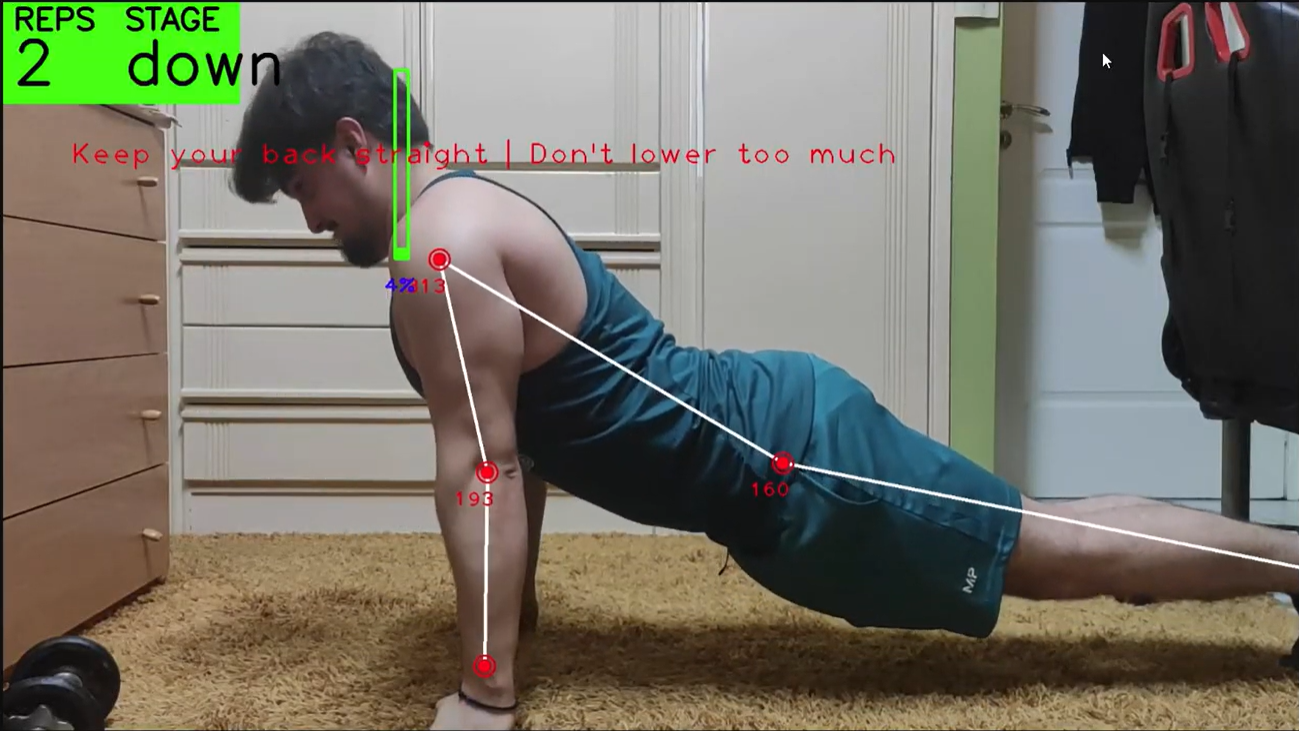
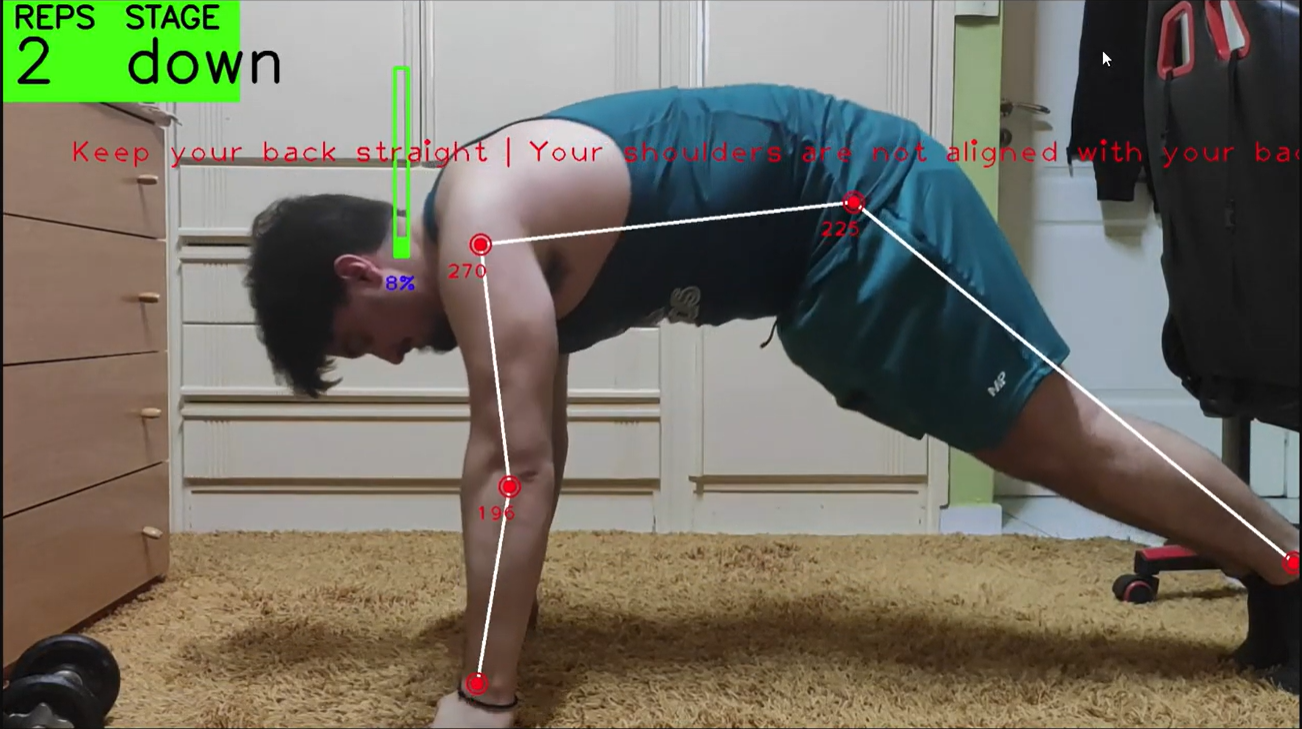
This is the working prototype, not a mockup: a skeleton overlay tracking the movement, the rep
counter and stage, a range-of-motion bar that fills and empties as the trainee moves through the
repetition, and the correction appearing in real time as the form breaks.
Two corrections caught mid-rep, with the joint angles the model is reading. This is the actual output of the computer-vision model, not a render.
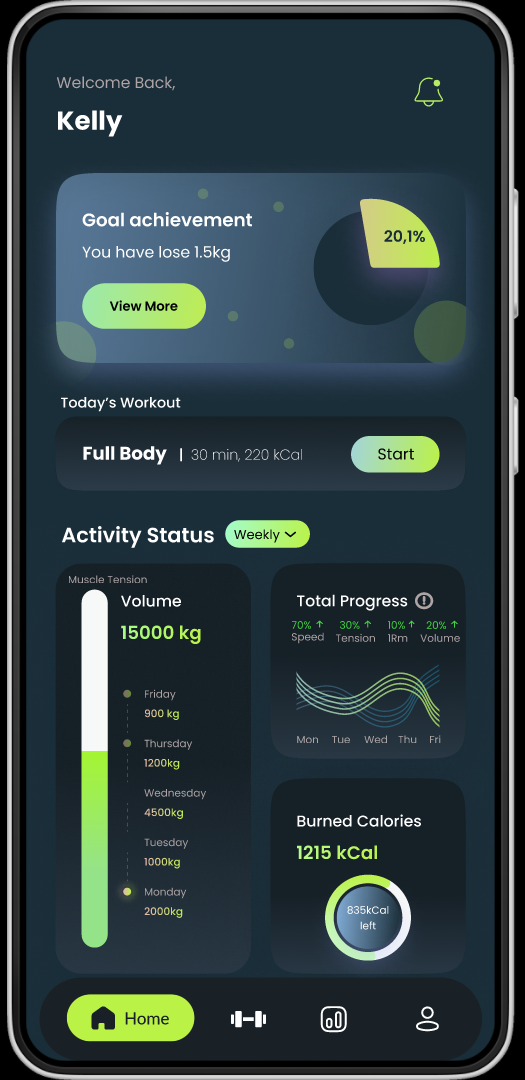
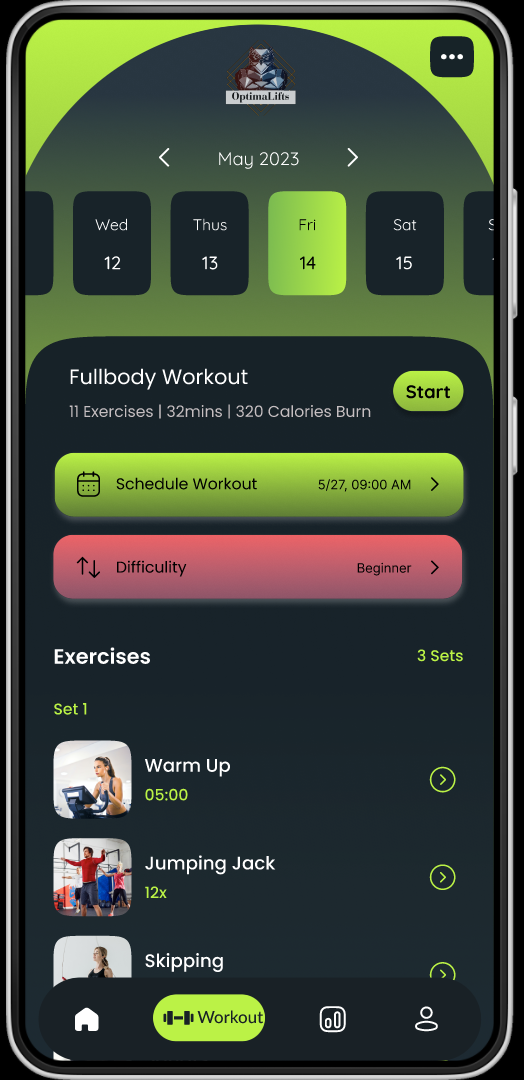
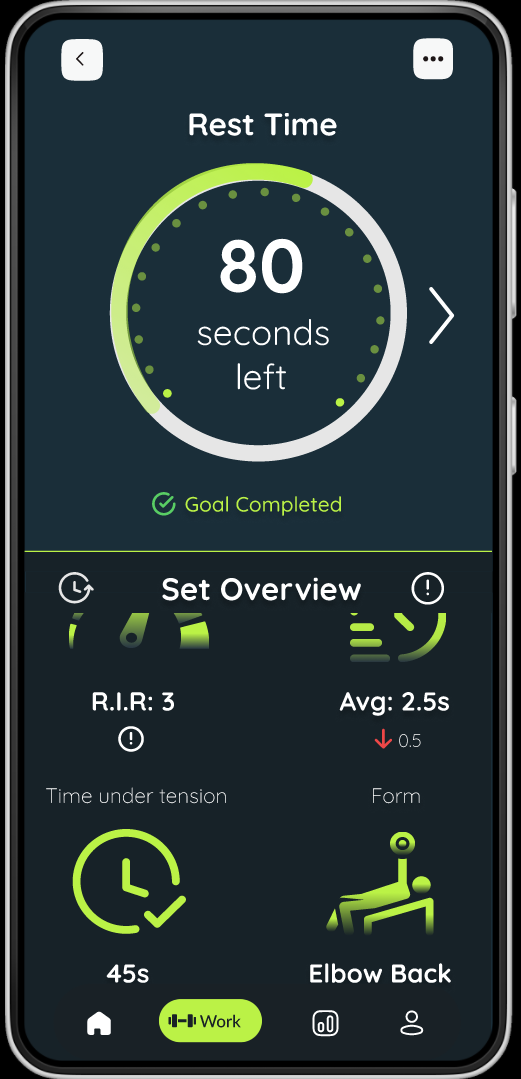
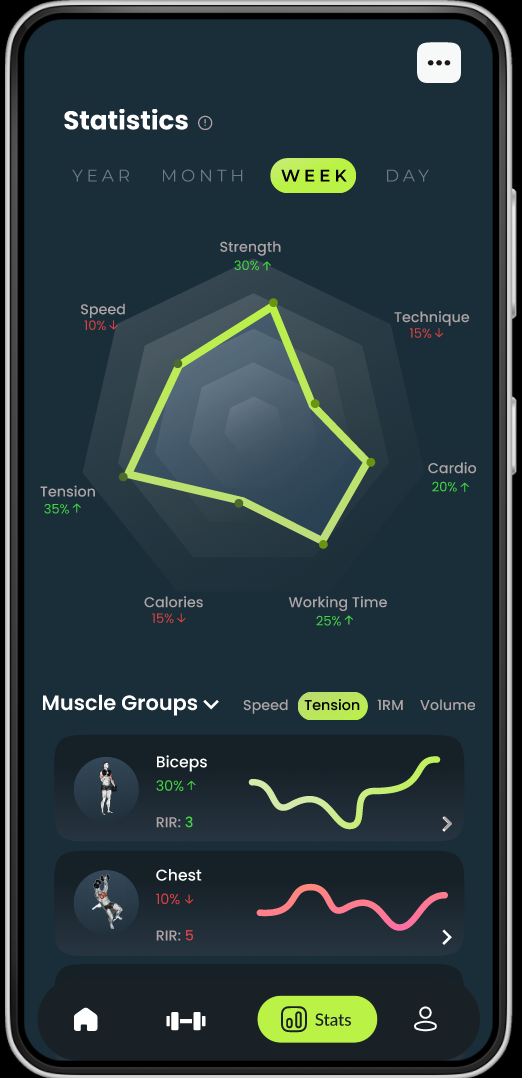
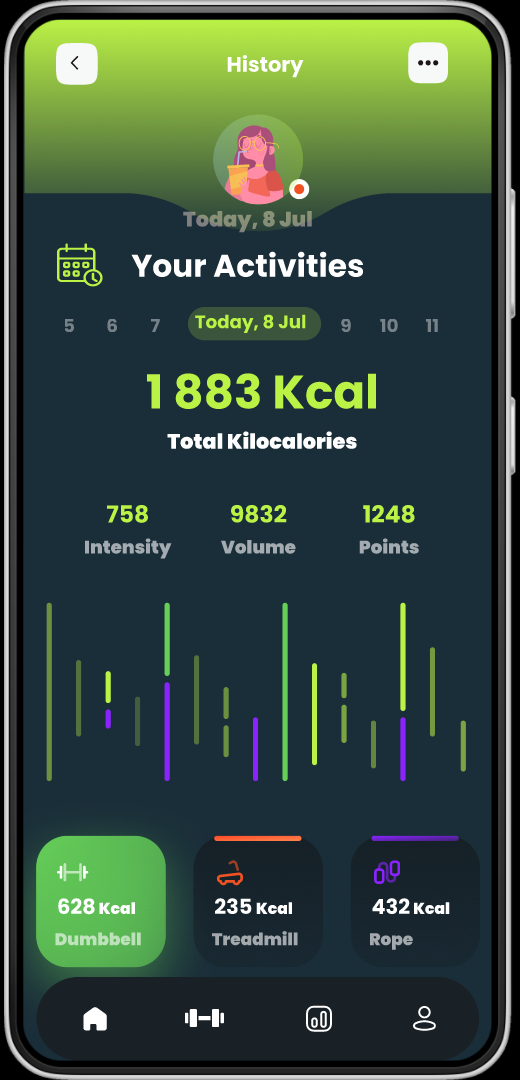
Alongside the working loop I designed the interface for the fuller product: a home dashboard, a
scheduled workout plan, the rest-timer analysis, a statistics view and workout history. The design
question running through all of them was what a lifter can act on at each moment.
Mid-set, the screen carries only what changes the current repetition, the rep count and stage, the
range-of-motion bar and the corrections, all of it readable at a glance from across the room and
none of it requiring a hand on the phone. Analytical detail such as R.I.R., time under tension and
per-rep tempo would be noise at that moment, so it waits for the rest timer, when the trainee has
eighty seconds and nothing to do with them. Matching the density of an interface to what the user
can actually use right then, rather than to how much data the product happens to have, is a habit I
have applied to every product since.
Design exploration beyond the shipped MVP: dashboard, workout plan, rest-timer analysis and history.
The business model for the camera version
Dropping the hardware invalidated the original model, which had leaned on equipment margin. I rebuilt
it as a pure software model with four layers, each one unlocked by the one before it.
Four layers, sequenced by what has to be true before each one can start earning.
Three of those decisions are worth explaining, because they are the ones a fitness product usually
gets wrong.
The coaching itself is free, across every exercise. The instinct is to paywall the
thing that makes you special, and in most categories that is right. Here it is backwards. Nobody
believes a phone camera can correct their squat until they watch it happen to them, so a hard
paywall would be charging for a claim rather than for a product. Locking most of the exercise
library behind that paywall fails for the same reason, so the free tier covers all of it. Industry
benchmarks bear this out: freemium in health and fitness converts at roughly 2 to 3%, while free
trials that let the user experience the product first convert far higher, up to around 49% for
card-gated trials. In a category built on a claim people do not believe, the demonstration
is the acquisition channel. What premium sells is not access to the coach, it is everything
the coach can tell you over time.
Premium defaults to annual, with monthly still available. Both periods are offered,
because forcing a year's commitment on someone who is not ready is a good way to lose them. Annual
is pre-selected and carries a real discount, and that is not a pricing trick. Progressive overload,
the thing the paid tier actually measures, only becomes visible over months. A monthly plan asks the
user to renew before the product has had time to prove anything, and invites churn precisely when
the value is about to appear. Annual billing aligns the billing period with the period over which
the product justifies itself, which is also why health and fitness is the one category where annual
plans dominate, at around 61% of revenue.
B2B sits third because it changes the product's shape, not just its price. A
trainer can only physically stand next to one client at a time, so per-seat licensing plus remote
form review turns the same model into something that scales a trainer's capacity rather than
competing with them. The aggregate insight layer sits last for the obvious reason: it does not exist
as an asset until the layers above it have produced enough data to be worth anything.
The incubator
OptimaLifts was selected into Compass Cycle, the year-long incubator track of
ACEin,
the Athens Center for Entrepreneurship and Innovation at AUEB, and completed it in 2024. It covered a
year of customer discovery, business modelling and growth planning with mentors, milestone planning
against a time plan, and regularly having to defend the roadmap to people with no reason to be polite
about it.
What I took from it
Put the uncomfortable criterion in the comparison table. Scoring "affordable and
discreet" as a row is what turned abandoning our own hardware into a calculation instead of an
argument. A constraint that lives only in someone's head loses to whichever option has the better
slide, every time.
Find the constraint that defines the product, then design everything around it.
Here it was timing: feedback had to land inside the rep or it was worthless. Once that was clear,
it settled the architecture, the scope and the interface without further debate.
Write the honesty requirement into the acceptance criteria. "Say you cannot see
the movement rather than guess" is a product decision, not an engineering one. Leaving it
unwritten means it gets traded away the first time someone wants a smoother demo.
A business model works as a sequence of layers. Free coaching, annual premium,
per-seat B2B, then data. Each layer exists because the one before it made it possible, and getting
the order wrong is how products with good economics on paper still fail.
What I would do differently: I validated the problem thoroughly and the
willingness to pay hardly at all. I had injury statistics and a competitor matrix long
before I had one person who had said they would pay for it. Now the pricing conversation happens
in week one, not in the financial model.
Let's talk
Hiring for a product role?
Product Manager, Product Owner or Business Analyst roles, in Dublin or remote in Europe.